

What a Project Management Virtual Assistant Can Do for Your Team
What a Project Management Virtual Assistant Can Do for Your Team
Keeping projects on track is hard work. Deadlines slip, tasks sit unfinished, and priorities change as new requests arrive. Even with good intentions, teams can lose momentum when no one is watching the small moving parts each day.
For many small businesses and start-ups, a full-time project manager is simply out of reach. Hiring costs, onboarding time, and overheads add up quickly, and it is not always practical when your workload fluctuates.
A project management virtual assistant is an innovative, budget-friendly way to keep things moving. A PM VA helps plan timelines, follow up on tasks, organise meetings, and keep your tools tidy so nothing gets missed. They work inside the systems you already use, provide clear updates, and give your team the headspace to focus on real work. With consistent support, you reduce delays, avoid last-minute scrambles, and finish more projects on time and within budget.
What Is a Task and Project Management Virtual Assistant?
A task and project management virtual assistant is your productivity sidekick. Their job is to make sure nothing falls through the cracks and that every moving part of a project is tracked, updated, and finished.
At a practical level, a PM VA will:
- oversee timelines and milestones
- track progress across teams and projects
- create and assign tasks to the right people
- send timely reminders and follow-ups
- Prepare simple, clear status reports you can scan in minutes
They do this inside the tools you already use. Whether it is Trello, Asana, Monday.com, or another platform, your PM VA keeps boards, lists, tags, and due dates clean and current. That way, everyone sees the same plan, knows what to do next, and stays aligned without constant chasing.
Core Responsibilities of a Project Management VA
Manage Your Task-Management Software
Your PM VA is the owner of your task tools. They set things up, keep them tidy, and make sure the right work moves at the right time.
What this looks like in practice:
- Create the project structure: boards, lists, views, tags, due dates, and owners.
- Turn briefs and meeting notes into clear tasks with priorities and timelines.
- Assign tasks to the right people, add context, and attach files or links.
- Keep everything current: update statuses, revise dates, close completed items, and archive old clutter.
- Maintain accurate notes and comments so anyone can understand the history at a glance.
- Watch for bottlenecks and nudge tasks forward before they stall.
- Own the quality of data in the system, including naming rules, tags, and standard fields.
Tools they can run: Trello, Asana, Monday.com, ClickUp, Jira, or your in-house setup. The goal is a clean, reliable workspace where your team knows what to do next without chasing answers.
Schedule Meetings and Follow-Ups
Your PM VA takes the hassle out of scheduling so your team can focus on the work.
What they handle:
- Book routine team check-ins, brainstorming sessions, client appointments, and cross-functional meetings.
- Coordinate time zones, room bookings, and video links, then send calendar invites with all the key details.
- Confirm attendance, share pre-reads, and follow up with anyone who has not responded.
Before the meeting:
- Draft a clear agenda with goals, talking points, timings, and owners.
- Build clean PowerPoint or Google Slides decks where needed, using your templates and branding.
- Gather files, links, and performance data so decisions can be made on the spot.
During and after the meeting:
- Capture notes and decisions in real time.
- Convert outcomes into actionable items with clear owners, deadlines, and priorities.
- Send a summary to attendees and stakeholders.
- Log tasks in your project tool, set reminders, and track progress so nothing goes missing.
Send Reminders and Summaries
Your PM VA keeps everyone informed at the right time and in the right place. Reminders and summaries are short, clear, and tailored to your team’s workflow so nothing slips.
How They Keep Work Moving:
- Send timely reminders in email, Slack, or your chosen tool with the task, owner, and due date.
- Flag upcoming deadlines, dependencies, and blockers before they turn into problems.
- Nudge owners on overdue items and offer quick options to reassign or adjust timelines.
- Batch routine reminders to reduce noise while keeping momentum.
Summaries You Can Scan in Minutes:
- Daily or weekly status notes with what is done, what is next, and who is responsible.
- One-page project snapshots for leaders with milestones, risks, and budget notes.
- Post-meeting wrap-ups that list decisions, actions, and deadlines.
- Channel-specific updates for sales, marketing, ops, or product so each team sees what matters to them.
Fit to your way of working:
- Match your tone, templates, and notification settings.
- Use simple labels and consistent formatting so updates are easy to read.
- Log all reminders and summaries in your task system for full visibility.
- Adjust cadence based on project pace, stakeholder preferences, and critical dates.
Prepare and Manage Documents
Your PM VA keeps project paperwork clear, tidy, and easy to use. They create the documents you rely on and maintain the systems that keep everything organised.
What they create:
- Project briefs that capture goals, scope, timelines, owners, and success measures
- Concise status reports that show progress, risks, next steps, and budget notes
- Templated presentations in PowerPoint or Google Slides that follow your brand
- Internal how to guides and playbooks for recurring processes
How They Keep Documents Under Control:
- Set up logical folders and naming rules so files are simple to find
- Maintain version control with dates, change logs, and clear owners
- Standardise templates for briefs, reports, and meeting packs
- Tag documents by project, team, or phase for quick search and filtering
Ticketing and workflow support:
- Create and manage tickets for requests and approvals
- Route items to the right people and track them to completion
- Close or archive tickets once work is delivered and documented
Quality and consistency:
- Proofread for clarity and accuracy
- Ensure links, references, and attachments work
- Keep a single source of truth so everyone works from the latest file
The result is a clean, reliable knowledge base where your team can find what they need fast and move forward without confusion.
Monitor and Manage Project Budgets
Your PM VA helps you stay on top of the numbers so projects finish on time and within budget.
What they do day to day:
- Track all expenses against the approved budget and forecast
- Keep a live budget sheet with actuals, committed spend, and remaining funds
- Match invoices and purchase orders to tasks or phases for clear reporting
- Update cost centres, codes, and notes so finance can reconcile quickly
- Prepare simple budget snapshots for weekly or fortnightly reviews
Controls that prevent surprises:
- Set spend thresholds and alerts for each project or workstream
- Flag variances early and explain the cause and impact
- Recommend options to adjust scope, shift timelines, or reallocate funds
- Log approvals for changes and keep a clear audit trail
Visibility for the whole team:
- Share short budget updates alongside status reports
- Highlight upcoming renewals, licences, and large payments
- Coordinate with suppliers to confirm quotes, delivery dates, and terms
With consistent tracking and early warnings, your team can make timely decisions, protect margins, and keep financial risks low.
Report on Task Progress
Your PM VA gives you a clear view of what is done, what is next, and what needs attention. Updates are regular, easy to scan, and tied to real tasks, owners, and dates.
What the updates cover:
- Task completion against plan with on-time vs overdue items
- Upcoming deadlines and dependencies that could affect delivery
- Current status of milestones and critical path
- Budget position versus timeline with any risks or variances
- Blockers, owners, and the next action to remove them
Formats that fit your team:
- One-page weekly summary for leaders with a simple traffic light view
- Team-level snapshots for sales, marketing, ops, or product with only their tasks
- Live dashboards or shared sheets that sync with your task tool
- Short daily notes during fast sprints or launch windows
Helpful visuals and indicators:
- Traffic light status for scope, schedule, budget, and risks
- Simple burndown or cumulative flow charts for the pace of delivery
- Risk and issue logs with owner and due date
- Trend lines that show whether you are catching up or falling behind
How it adapts to your setup:
- For a single project, the VA reports directly to the project owner with deeper detail
- When embedded in a function, the VA rolls up multiple projects into a clean team view
- Cadence, format, and KPIs are tuned to your workflow and stakeholder preferences.
With consistent, right-sized reporting, leaders make decisions quickly, teams stay aligned, and projects remain on schedule and within budget.
Manage Your Project Calendar
Your PM VA keeps a single, shared calendar that everyone can trust. Deadlines, milestones, and key meetings all live in one place so the team knows what is coming up and when to deliver.
What they coordinate:
- Project deadlines with clear owners and handover dates
- Milestones for major phases, approvals, and launch gates
- Routine stand-ups, sprint reviews, client touchpoints, and cross-team check-ins
- Reminders for renewals, licence dates, and supplier lead times
How they prevent clashes
- Monitor calendars across teams and time zones to spot conflicts early
- Reschedule quickly and confirm new times with all stakeholders
- Realign dependent tasks and update timelines in your project tool
- Notify owners of any changes and record them in meeting notes and status reports.
Good calendar hygiene:
- Use consistent naming, tags, and colour coding
- Include meeting links, agendas, and attachments in each invite
- Set sensible reminder timings so people arrive prepared
- Review the calendar weekly to keep it accurate and relevant
With one well-maintained calendar, teams plan better, meetings run on time, and projects move smoothly from task to milestone to finish line.
What a Project Management VA Can’t Do
A project management VA is an administrative specialist, not a certified project manager or Scrum master. They focus on keeping work organised and moving. They do not set a delivery strategy or run complex technical programs.
Outside their scope:
- Design or oversee project management frameworks such as Agile, Waterfall, or hybrid models
- Make high-level strategic decisions about scope, resourcing, or trade-offs
- Manage technical delivery teams or act as a product owner or tech lead
- Lead sprint planning, sprint reviews, or retrospectives without guidance from a qualified lead
- Create brand new workflows or operating models from scratch without a clear brief
- Own risk management for complex programs, compliance, or safety-critical work
- Approve budgets or contracts on behalf of the business
Your VA is there to support the system you already use. With the right direction from a project lead, they help the team run smoothly and keep the admin tight.
Benefits of Hiring a Project Management VA
Save Time and Improve Efficiency
A PM VA takes the busywork off your plate so the team can focus on meaningful tasks. They handle the admin that quietly slows projects down. Calendars are organised, task lists stay current, and updates reach the right people at the right time.
How a VA saves hours each week:
- Turns meeting notes into clear tasks with owners and dates
- Sends reminders before deadlines so nothing slips
- Chases approvals and assets from clients or suppliers
- Keeps boards and spreadsheets tidy so leaders see real progress
- Prepares short status notes you can read in minutes
What this means for your team:
- Leaders spend less time coordinating and more time making decisions
- Specialists focus on delivery rather than updating tools
- Fewer last-minute scrambles because dependencies are flagged early
- Cleaner handovers between teams, with the next steps already assigned
With the routine work handled, projects move along without constant oversight, and your team gets more done in the same week.
Keep Your Team Focused
When a PM VA runs the process, your team can stay in their lane and do their best work. The back and forth of scheduling, follow-ups, and status chasing is handled in the background, so people are not pulled into admin.
How a VA protects focus:
- Shields specialists from constant pings by routing questions through one point of contact
- Prepares agendas and pre-reads so meetings are short and purposeful
- Logs actions with owners and dates, then follows up quietly to keep momentum
- Keeps tools updated so no one wastes time hunting for the latest info
Impact on performance:
- Fewer context switches and fewer interruptions during deep work
- Clear priorities each day with next steps already mapped
- Less stress as deadlines are visible and dependencies are managed
- Better quality output because experts can stay with the task that matters
With the coordination load off their plate, your people can concentrate on creating, building, and serving customers while the VA keeps the engine running.
Give Your Teams the Support They Need
When the workload spikes, a PM VA keeps the pressure under control. They smooth out busy periods, make sure priorities are clear, and help the team avoid burnout.
How a VA supports healthy delivery:
- Balance workloads by tracking who has capacity and redistributing tasks where possible
- Spot clashing deadlines early and coordinate changes with owners and stakeholders
- Maintain a shared view of priorities so everyone knows what matters this week
- Set realistic timelines, note dependencies, and highlight risks before they escalate
- Check in on progress and remove simple blockers like missing files or approvals
Why it matters:
- Teams stay focused on the right tasks instead of firefighting
- People get fewer last-minute surprises and overtime requests
- Leaders gain clear visibility into strain points and can act sooner
- Morale improves because plans feel achievable and support is consistent
With steady coordination and practical help, your team can deliver at a strong pace without running themselves into the ground.
Only about a third of organisations finish on time. A PM VA helps you beat the odds by keeping momentum steady and communication clear.
How a VA keeps delivery on track:
- Sends timely, personalised follow-ups before due dates so nothing slips
- Flags risks early and proposes simple fixes like reassigning or breaking work into smaller steps
- Confirms handovers between teams so the next task starts without delay
- Keeps the plan current with real dates, owners, and dependencies
- Shares short status notes that show what is done, what is next, and who is responsible
What you will notice:
- Fewer last-minute scrambles and fewer missed tasks
- Meetings start on time because files, links, and agendas are ready
- Stakeholders stay informed, which reduces back and forth and rework
- Deadlines are realistic and visible, which makes delivery smoother
With a steady rhythm of reminders, updates, and clear handoffs, projects move forward at a consistent pace and deadlines are met more often.
Save Money
A PM VA gives you the structure of project management without the cost of a full-time hire. You get organised workflows, transparent reporting, and steady follow-ups while keeping payroll lean.
Why is it cost smart
- Pay only for the hours and support you need
- No employee benefits, training costs, or lengthy onboarding process
- Flexible coverage that scales up during busy periods and down when things are quiet
- Fewer delays and do-overs, which reduces wasted spend
Ideal for small teams and solo founders:
- Add reliable bandwidth quickly without adding headcount
- Keep tools tidy and tasks moving so you do not need an in-house coordinator
- Focus your budget on delivery while the VA handles the admin
With targeted support at a fraction of the price, you control costs and still get the organisation your projects need.
Conclusion:
For robust coordination, opt for a managed VA service that provides trained assistants, transparent processes, and quality checks. Providers like Prialto add performance management, holiday cover, and easy scaling. You also gain cost control and strong security practices, which help you keep projects moving without adding headcount.
A project management VA is an admin specialist who keeps tasks, timelines, and communication organised. They maintain momentum, tidy your tools, and keep stakeholders informed. Your team can concentrate on strategy and delivery while the VA handles follow-ups, scheduling, and reporting. The result is smoother projects and more time for growth.

Why Every Growing Marketing Team Needs a Virtual Assistant
No business owner or marketing manager ever says, “I’ve got too much time on my hands.”
Marketing teams often juggle content, social media, analytics, lead generation, and client reporting, sometimes all in the same day. While strategy and creativity should be at the heart of your team, many find themselves buried in routine tasks that drain time and energy.
That’s where a marketing virtual assistant comes in.
They’re not just there to check off a to-do list. A good assistant frees up your in-house team so they can focus on bigger projects, drive creative campaigns, and deliver results where it counts.
Let’s look at how a virtual personal assistant can make a measurable difference to your marketing efforts.
Virtual assistants with AI cut response times for marketing and customer queries by up to 60% according to WiFi Talents.
Taking Over the Repetitive but Necessary Tasks
Every marketing team has those tasks that have to get done but don’t require senior-level expertise. Things like:
- Scheduling social media posts
- Updating website content
- Sending follow-up emails
- Managing CRM data
- Organising content calendars
These aren’t complicated jobs, but they’re time-consuming. Having a virtual assistant handle them means your in-house team isn’t stuck on admin. They stay focused on strategy, creative work, and campaigns that actually drive growth.
And because most virtual assistants are already trained in tools like Hootsuite, HubSpot, Mailchimp, and basic CMS platforms, there’s little hand-holding required once you set clear expectations.
As these are affordable VAs, you will easily save at least $15 an hour.
Better Time Management Without the Overhead
Hiring another full-time employee isn’t always practical, especially for tasks that don’t fill an entire role. That’s where a virtual assistant service becomes valuable.
You can bring someone on board for the hours or projects you need. Whether it’s 10 hours a week or support during campaign launches, you only pay for what you use.
This approach also means you avoid extra costs like office space, hardware, payroll tax, or onboarding processes that come with permanent hires.
Helping Your Team Stay Focused on Core Projects
Distractions kill productivity. And it’s not just about wasting time, it’s about losing focus on high-value work.
When your marketing coordinator is constantly toggling between writing reports, updating spreadsheets, and handling scheduling, they aren’t giving their best to strategy or creative thinking.
A marketing virtual assistant can filter those low-priority but necessary tasks out of their day. The result? Your core team stays sharper and more focused on delivering the big-ticket projects that actually move the needle.
Supporting Campaigns with Research and Data
Market research, competitor tracking, SEO audits, and content performance reports all need to be done. But they don’t all need to be handled by your senior staff.
Many virtual personal assistants come with solid research skills and experience using analytics tools like Google Analytics, SEMrush, or Ahrefs.
They can gather data, create summary reports, and even draft initial insights that your team can use to make informed decisions. This keeps your team out of the weeds and focused on strategy, without sacrificing the research needed to stay competitive.
CRM Updates and Lead Management
Keeping your CRM accurate is a daily task, and one that’s often pushed aside until it’s too late.
A marketing VA can update lead records, track follow-ups, and manage email sequences, making sure nothing slips through the cracks.
Many assistants are trained on popular CRM platforms like Salesforce, Zoho, or HubSpot. They can log interactions, tag contacts, and ensure your sales and marketing alignment stays tight.
When your CRM is clean and up to date, it means your team is working with reliable data, and that directly improves sales follow-ups and campaign results.
Technical Support for Everyday Marketing Tasks
A good marketing assistant isn’t just admin support. They often bring technical know-how in tools that your team uses every day.
This includes setting up automated workflows, creating basic graphic assets in Canva, updating WordPress pages, and even assisting with landing page builds using platforms like Unbounce or Leadpages.
They’re not replacing your designers or developers, but they can handle the setup work and basic tasks. So, you can focus on higher-level creative and development projects.
Final Thoughts: A Smart Move for Growing Teams
Bringing in a virtual assistant can free up your team, reduce admin work, and make sure your campaigns stay on track, all without the cost or commitment of a full-time hire.
When you choose the right person, they become an extension of your team.
At Kredence Global, we match businesses with marketing virtual assistants who are skilled, reliable, and easy to work with. We take care of the screening, onboarding, and background checks so you don’t have to.
We have worked with clients across the industry and provided the best virtual assistant for both short-term and long-term projects.
If you’re ready to give your team the breathing space they need to focus on big-picture projects, get in touch with us today.


Why Every Travel Agency Needs a Virtual Bookkeeper in 2025
Running a travel agency means juggling bookings, vendors, refunds and bank feeds. When your back office turns into a tangle of overdue invoices and missing commissions, stress takes off. This guide shows how a professional bookkeeper working online can clear the backlog, protect your cash flow and give you peace of mind—all without hiring on-site staff.
Why Travel Agencies Lose Money Without a Dedicated Bookkeeper?
Travel agents thrive on speed and accuracy, yet financial tasks often fall to the bottom of their to-do lists. That spreadsheet you swear you’ll update “this weekend” ends up neglected, and minor errors add up to significant losses. Late or missed payments from airlines and hotels can leave your agency chasing money that should already be in the bank. Specialised bookkeeping service for travel keeps every transaction tracked and every dollar accounted for, so you stop leaking funds before they vanish.
Common Cash Leaks in Travel Agencies
- Missed or Late Commissions: Suppliers, such as airlines, cruise lines, and hotel chains, often have complex pay-out schedules. If you don’t match every booking to its payment, your cash flow looks healthier than it is.
- Duplicate Vendor Payments: Without a clear system, one person might pay an invoice only to have another team member pay it again. The refund process can take weeks to complete.
- Overlooked Chargebacks and Refunds: Cancelling a tour or group booking should trigger an automatic request for credit. If nobody’s monitoring, those amounts slip through and vanish.
- Idle Subscription Fees: You may still pay for an itinerary planner you tested or a CRM you stopped using ages ago. A smart review flags unnecessary recurring charges before they become a hefty line item.
Typical Bookkeeping Errors You Want to Avoid
- Mixing Personal and Business Expenses: Charging a weekend escape on the agency card without clear notes makes tax time a headache. Every swap must be coded correctly.
- Inaccurate Commission Tracking: Each supplier has its reporting format. If you rely on a generic spreadsheet, you risk missing pay-outs that are rightfully yours.
- Ignoring Seasonal Downturns: The high season covers your costs—but slow months test your reserves. Without cash forecasts, you could face tight budgets when bookings dip.
- Letting Refunds Slip: Every cancellation is eligible for a refund or credit. Failing to record these properly skews your revenue reports.
- DIY Systems That Don’t Scale: A notebook or half-finished Excel file may work for a start-up, but when growth kicks in, you need a consistent, auditable platform.
Why Virtual Bookkeepers Lead the Way in 2025?
Travel moves fast, and so should your accounts. Here’s why agency owners choose online specialists:
- Around-the-Clock Updates: Time zones don’t matter. Your records get updated while you sleep, catch flights or meet customers.
- Travel Industry Experience: They are familiar with BSP reports, OTA pay-outs, and supplier invoice codes—no need for lengthy training.
- No Onboarding Hassles: You tap into pre-vetted talent and avoid lengthy interviews. Integration with tools like Xero or QuickBooks is seamless.
- Cost-Effective Model: Pay only for the hours you use. It is ideal to have both a busy season and a quiet season.
- Actionable Insights: More than just data entry, you gain someone who identifies declining commissions and cash flow bottlenecks and helps you plan.
How to Bring a Virtual Bookkeeper on Board
- Define Your Needs: List tasks that you want the virtual bookkeeper to handle—reconciliations, supplier payments or revenue reports.
- Check Industry Credentials: Look for a specialist with travel agency know-how.
- Assess Communication Channels: Agree on reporting schedules and preferred tools for updates.
- Trial Period: Start small to confirm fit and efficiency.
- Scale as You Grow: Increase hours when you need extra support, such as during peak season or promotional campaigns.
Beyond Bookkeeping: Broader Virtual Support Options
- A virtual admin assistant can manage your inbox and appointment bookings.
- If you need more hands on deck, you can hire virtual assistants for customer follow-ups or marketing-related activities.
- Some businesses opt for a comprehensive virtual assistant service package that encompasses administration, finance, and social media.
- For one-on-one help, a virtual personal assistant offers tailored support to free up your day.
Final Thoughts
Missing payments, duplicate invoices and manual bookkeeping slow you down. A specialised online bookkeeper gives your travel agency the clarity and cash flow it needs. The expert virtual support works on your behalf, allowing you to focus on planning trips instead of chasing payments.
Reach Out to Kredence Global
Ready to clear your accounting backlog and safeguard your cash flow? Kredence Global delivers expert virtual bookkeeping and complete virtual assistant services for travel agencies. Reach us on 1300 114 222 to set up your free consultation today.

Why Smart Businesses Are Replacing the 9-to-5 with Virtual Assistants
The traditional 9-to-5 workday doesn’t work for everyone. More businesses are learning that it might not be working at all.
Remote teams are stepping in and showing results. In many cases, they’re outperforming in areas that really matter.
From small businesses to legal firms, more organisations are ditching the full-time desk model and choosing to hire a virtual assistant or build flexible teams that work remotely. Why? Because results talk, and they’re hard to ignore. Should you get a virtual personal assistant? Let’s talk about it.
More Output, Less Overhead
Let’s start with the easy win. When you bring in a virtual admin assistant, you don’t have any expenses. As they work from home, they pay for their rent, electricity, and all other expenses.
Also, you can get maximum output from them. The real gain isn’t just in saving money. It’s about focus. Virtual teams tend to work smarter. There’s no small talk, no commuting, no fluff. Just solid work. Most assistants clock in, knock out their task list, and move on. You’re not paying for idle time.
Time Management That Actually Works
The 9-to-5 model assumes everyone is productive at the same time. We know that’s not true.
Remote teams aren’t bound to the same clock. This helps them work when they’re most focused. That’s especially useful when you’re working with a virtual personal assistant who’s handling critical admin while you’re in court, on the job site, or in meetings.
Time is better used, and work gets done faster. You’re not waiting for someone to free up at 3 PM because they’re stuck in back-to-back meetings.
Real KPIs. Real Results.
The numbers speak clearly. Virtual setups consistently improve task completion rates, reduce turnaround time, and boost overall output.
That’s the kind of improvement businesses are chasing. And they’re finding it with a virtual assistant service.
Less rework, better accuracy, and faster communication. You get clearer results because you’re working with people who specialise in specific tasks and do them daily.
When companies hire a virtual assistant from Kredance Global, they have seen better results in the KPIs they measure compared to a 9-to-5 employee.
Accountability Goes Up, Not Down
There’s a common fear that remote workers slack off. But in reality, it’s the opposite, especially when you hire through a structured agency like Kredance Global.
Most virtual admin assistants work with set KPIs. They log their time, track what they’ve done, and report progress regularly. When people are measured on work completed, not just hours logged, accountability becomes a natural part of the process.
This leads to better outcomes across the board. No one is hiding behind busy calendars or office politics.
Flexibility That Drives Growth
Need someone just for invoicing? Only during peak seasons? That’s the beauty of going virtual.
With remote teams, you can scale support up or down as needed. You’re not tied to full-time wages or lengthy hiring processes. You can adjust support based on the actual workload, not assumptions.
This is perfect for fast-growing teams that need help without locking into permanent contracts.
Less Burnout. More Engagement.
Let’s be honest. Traditional office setups are exhausting. Long commutes, rigid hours, and office noise do nothing for morale.
Virtual workers generally have a better work-life balance. That means they show up more focused and consistent.
Instead of running on fumes, they’re working in blocks of time that match their own energy levels. You get the benefit of clear minds and fresh ideas without forcing people into a schedule that doesn’t suit them.
What the Technical Side Tells Us
This isn’t just about perception or anecdotal wins. There’s data backing it up.
According to a 2023 survey published by Zippia, virtual assistants will help you reduce operating costs by up to 78%. That figure includes everything from salaries to overheads, such as office equipment and administrative software.
There is also evidence that virtual workers report higher job satisfaction, resulting in more consistent output. For employers, that means fewer errors, less turnover, and better continuity.
With cloud-based task managers like Basecamp, Asana, Trello, and ClickUp being standard across industries, you don’t need a whole IT department to manage your remote setup. Even legal and healthcare practices are moving parts of their operations off-site with little to no disruption.
Final Thoughts
You need to hire the right people if you want more output from remote workers.
That’s where Kredence Global comes in.
We’re not a freelancing platform. We’re a virtual assistant service that matches you with experienced, verified professionals who know how to get the job done.
Whether you need full-time support or a few hours a week, we’ve helped businesses across Australia build flexible admin teams that actually move the needle.
We handle the screening, the setup, and the support. You focus on growing your business.





The Ultimate Guide to Hiring a Virtual Assistant: Benefits, Costs, and Best Practices
Running a business today means managing numerous responsibilities; time is your most precious resource. Virtual assistants have emerged as a practical solution for busy entrepreneurs, offering remote support for tasks such as administration, customer service and social media management. By outsourcing these duties to a skilled professional, you can focus on activities that drive growth.
Many solopreneurs, start-ups and established firms in Australia engage overseas talent from countries such as the Philippines and India. These experts deliver quality work at affordable rates without the expenses associated with in-house staff. With remote work now commonplace, this model offers remarkable adaptability and efficiency.
What is a Virtual Assistant?
A virtual assistant (VA) is a remote expert who provides various support services to businesses, entrepreneurs, and individuals. They operate from different locations and communicate via email, video calls, and cloud platforms. Typically engaged as freelancers or contractors, VAs grant access to specialised skills without committing to a permanent employment contract.
Virtual assistants can undertake a broad spectrum of tasks based on their background and your requirements. They may handle general admin duties, including calendar management, email responses, file organisation and appointment bookings. Creative services such as content writing, graphic design and social media coordination are standard offerings. Some virtual IT assistants specialise in website maintenance, database management or CRM system updates. They function like an in-house team member, minus the physical presence.
The key advantage of working with a virtual assistant is the flexibility in engagement levels. You can retain support on a weekly basis or scale up to ongoing, full-time assistance. Since most VAs serve multiple clients, they maintain competitive pricing structures. This approach enables you to secure essential support without the financial overheads associated with permanent staff.
Who Should Consider Hiring a Virtual Assistant?
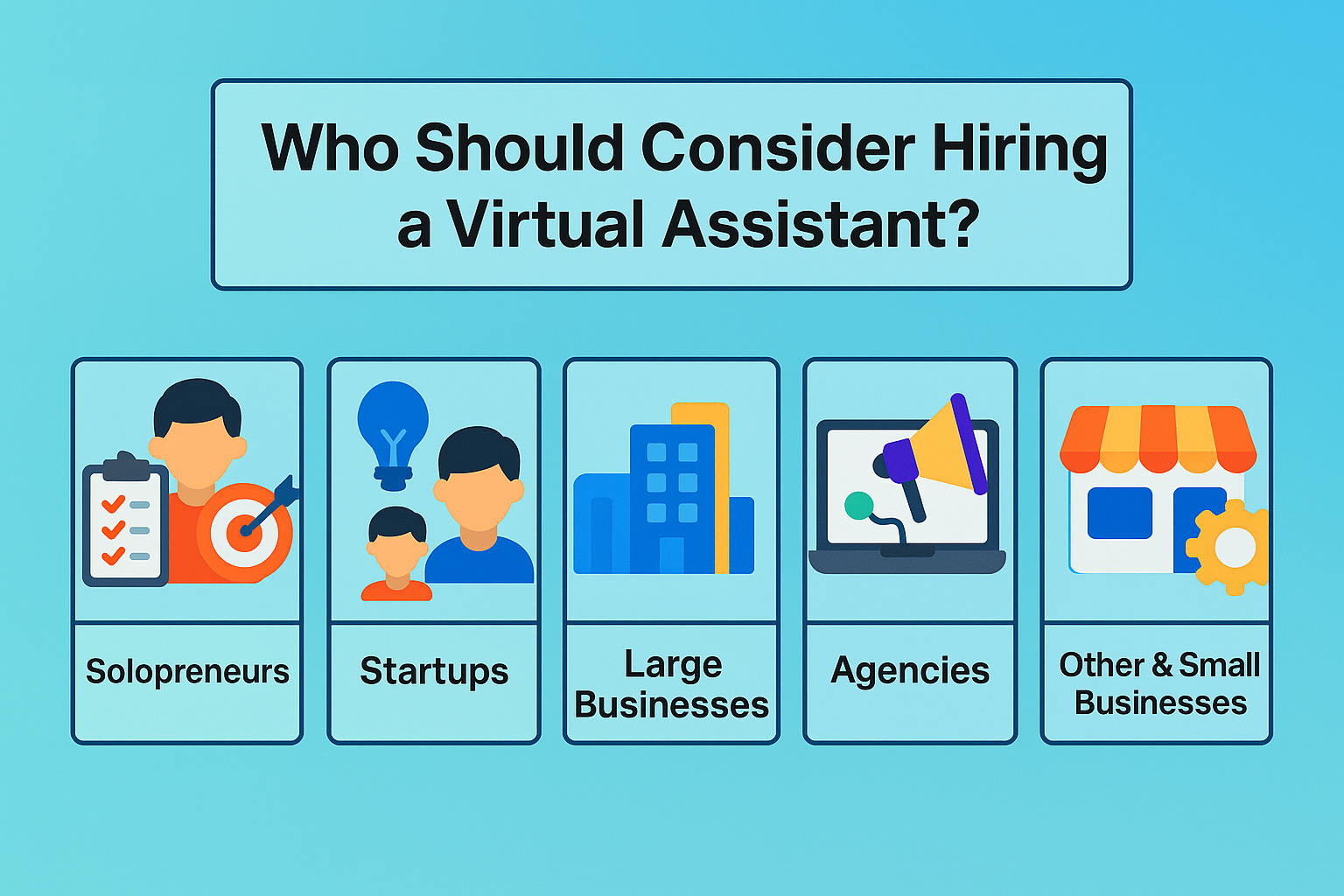
Solopreneurs
Running a solo operation can lead to an overloaded schedule and an increased risk of burnout. Tasks such as data entry, email handling, and scheduling can consume a large portion of the day, detracting from strategic planning and service delivery. A virtual assistant can assume these routine responsibilities, allowing you to focus on cultivating new opportunities, enhancing service quality, and maintaining a work-life balance.
Start-ups
Start-ups frequently operate under budget constraints and tight deadlines. Team members often juggle diverse functions, making it difficult to dedicate sufficient time to specialised tasks. Virtual assistants provide a cost-effective way to access specialised expertise, whether it involves customer support, bookkeeping, inbox management, or lead generation. Engaging remote professionals can help stretch limited funding further, enabling your core team to focus on product development and market expansion.
Large Businesses
Well-established companies can benefit from virtual assistants by offloading overflow work or tasks that fail to justify full-time in-house roles. Offshore VAs can manage admin duties, data entry, and customer service, reducing labour costs and freeing up office resources. With correct integration processes, these assistants operate seamlessly alongside internal teams, ensuring high standards of quality and efficiency without expanding your headcount.
Agencies
Marketing, creative, and consulting agencies often face fluctuating workloads. One month may see a flood of new client projects, while the next could be relatively quiet. Hiring a virtual assistant allows agencies to scale their workforce up or down in response to demand. You can engage specialists such as copywriters, graphic designers or administrative support to meet tight deadlines and deliver consistent results without the long-term commitment of permanent hires.
Small Business
For small businesses, juggling numerous tasks, missing deadlines, or overlooking details can harm their reputation and growth. A virtual assistant can tackle everyday jobs like data entry, meeting scheduling, and client follow-ups, helping to streamline operations and boost productivity. This additional support lightens the load and enables you to concentrate on core activities that drive profit and customer satisfaction.
Benefits of Hiring a Virtual Assistant
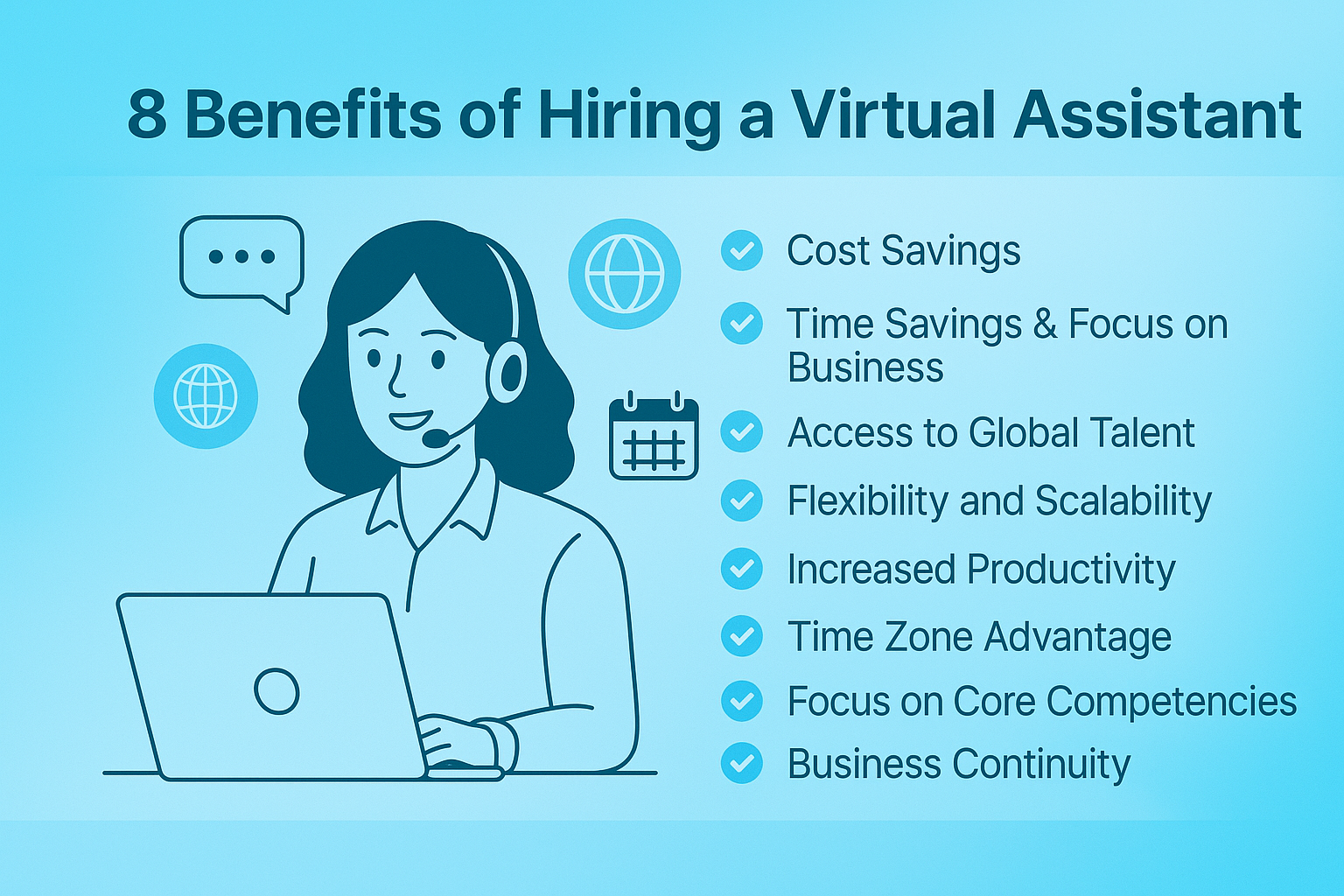
Outsourcing routine duties to remote professionals can transform how your business operates. If you hire virtual assistants, you can access experienced support for calendar coordination, email management and social media oversight. This model reduces pressure on in-house resources and delivers clear returns on investment. Overseas experts—especially those based in the Philippines or India—offer competitive rates without compromising standards. Small enterprises, start-ups and larger firms can all benefit from flexible help that aligns with changing workloads, allowing core teams to concentrate on revenue-generating activities and strategic growth.
➤ Cost Savings
One of the most significant advantages of engaging a virtual assistant is reduced labour expenses. Employing a local full-time team member in Australia requires payment of salary, superannuation, paid leave and workers’ compensation, as well as investment in office space and equipment. These costs accumulate rapidly and can strain budgets, particularly for small-scale operations.
Offshore assistants typically charge fixed monthly charges. While the typical full-time wage in Australia is about AU$1,770 per week, a skilled VA might represent only a small portion of that figure. This arrangement removes long-term contracts and benefit obligations, creating a cost-efficient support system.
➤ Time Savings and Focus on Core Business
Busy entrepreneurs often find themselves swamped by activities that keep the business running but do not drive development. Routine chores such as appointment scheduling, invoice processing and inbox management absorb hours you could spend on strategic initiatives. Delegating these jobs to a virtual assistant restores that time. Those additional hours might be invested in refining service offerings, growing your customer base or exploring new market segments. Maintaining a clear timetable allows business owners to shift from problem-solving day-to-day issues to planning for future success, contributing to improved decision-making and reduced stress levels.
➤ Access to Global Talent
Remote hiring enables access to specialists worldwide, rather than being limited by local availability. Businesses can engage skilled professionals in bookkeeping, digital marketing, social media administration, graphic design or customer support via reputable platforms. You can also engage virtual IT support assistants who handle website maintenance, CRM updates and database management. Many of these experts have collaborated with clients across diverse industries, allowing them to integrate seamlessly into existing workflows. Securing talent from markets such as the Philippines or India provides businesses of any size with strong technical and creative abilities at affordable rates, empowering them to incorporate expert input without incurring substantial overheads.
➤ Flexibility and Scalability
Adapting support levels to match fluctuating needs is straightforward with virtual assistants. You might begin initially for a month, then increase capacity as projects expand or seasonal demands peak. Conversely, if workloads ease, you can make adjustments without redundant processes. This agile model helps maintain an optimal staffing balance and effectively control costs. Since no long-term obligations are attached, your operation remains nimble and resilient. It is possible to engage multiple assistants specialising in different functions, ensuring that someone with the right expertise manages each task.
➤ Increased Productivity
Delegating routine tasks to experts contributes to smoother internal workflows and higher output. Entrepreneurs with multiple roles often find critical assignments delayed, risking missed opportunities. When a VA manages duties such as data entry, file organisation and email triage, your team can focus on high-impact initiatives. Research suggests remote workers frequently achieve greater productivity rates than their office-based counterparts due to fewer disruptions and the capacity to work during their most productive hours. Clearing low-impact chores from a schedule helps maintain momentum on projects that directly influence growth and client satisfaction, yielding measurable performance gains.
➤ Round-the-Clock Operations
Employing assistants across various time zones lets the business continue beyond local office hours. For example, an assistant in India may complete tasks overnight Australian time, so you begin each morning with fresh deliverables. Meanwhile, professionals in the Philippines often work with only a short time difference, allowing for collaboration during standard business hours and coverage at the edges of the day. This arrangement keeps projects on track and offers rapid response to customer inquiries outside typical service windows. Continuous coverage can strengthen your reputation by ensuring prompt handling of urgent matters and steady progress on key deliverables.
➤ Focus on Core Competencies
Every venture has primary capabilities that set it apart in the marketplace. Innovation can stall when core staff are diverted to administrative or support duties. A virtual assistant can assume responsibility for secondary tasks such as invoice preparation, meeting coordination and report compilation. With these activities assigned to an expert, your specialists can concentrate on product development, strategic planning or client-facing initiatives. Concentrating resources on high-value pursuits encourages superior outcomes and fosters ongoing improvement in your central offerings. This clear division of labour enhances both performance quality and employee satisfaction.
➤ Business Continuity
Remote assistants contribute to stability by operating independently of any single location. If your local office faces disruptions such as power cuts, extreme weather or network failures, offshore support teams can continue handling essential functions. Geographic diversity reduces vulnerability to local incidents and safeguards against extended downtime. Tasks like client communication, order processing and administrative maintenance can proceed without interruption. This resilience ensures that critical operations and deadlines are met despite sudden events. Businesses with geographically dispersed support maintain a stronger defence against interruptions and can keep service levels under challenging circumstances.
Everyday Tasks to Outsource to a Virtual Assistant
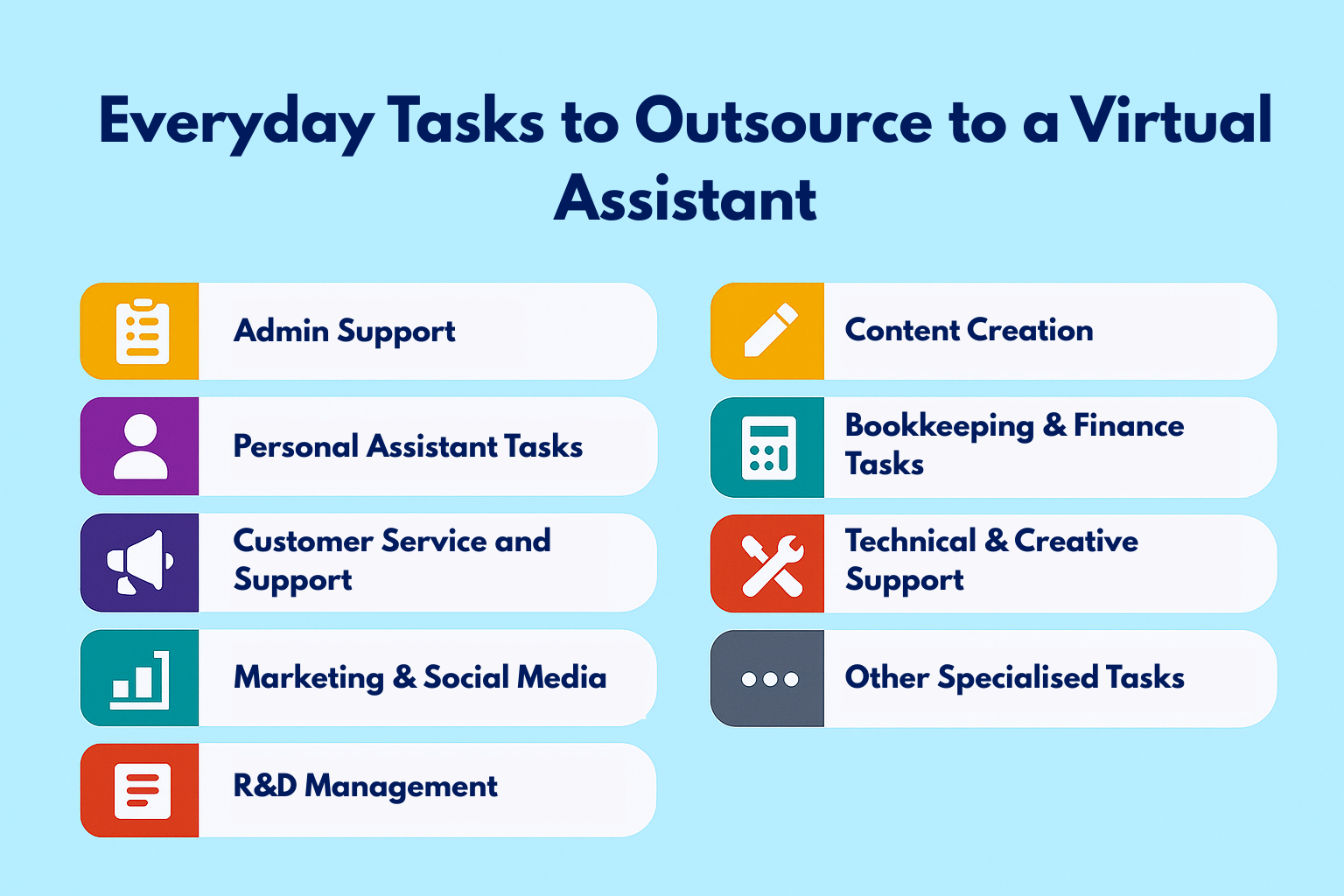
Managing daily operations can overwhelm even the most efficient business. If you hire virtual assistants, you create a flexible workforce that adapts to your needs, allowing your team to focus on core objectives. From simple administrative duties to complex technical tasks, remote professionals can step in as required while you retain control over outcomes. With a growing network of skilled individuals around the globe, organisations of all sizes now access expert help without the overheads of a permanent hire.
Here are the key categories of work commonly delegated to these remote contributors.
Administrative Support
Routine administration tasks can drain time without requiring constant supervision. Virtual admin assistants specialise in managing email inboxes by sorting incoming messages, flagging priorities and responding to standard enquiries. They oversee calendars, schedule appointments and set reminders to help you stay on track. Travel bookings, accommodation arrangements and itinerary preparation also fall within their remit, saving hours spent coordinating logistics. Additionally, these professionals handle data entry, format documents according to your brand guidelines and maintain organised digital filing systems. Delegating these chores to a remote expert ensures seamless day-to-day operations, leaving your onsite team free to tackle high-priority projects.
Personal Assistant Tasks
Juggling professional responsibilities alongside personal commitments can blur boundaries and lead to burnout. Assigning household administrative chores to your remote helper brings back balance. Your assistant can manage reminders for birthdays and anniversaries, arrange medical appointments or source the best suppliers for gifts and services. They handle subscription renewals, coordinate courier pickups and compare insurance or consumer electronics options before presenting concise summaries. Such support keeps personal affairs in order without distracting from business goals. An effective remote personal assistant ensures that neither work nor home life is neglected, maintaining harmony across both spheres.
Customer Service and Support
Prompt and professional responses define your brand reputation. Outsourcing client enquiries to a remote professional means your customers receive timely attention via email, live chat or phone, even outside standard office hours. Offshore contributors in different time zones can extend your support window, resolving common issues and escalating complex cases to your in-house team. A remote associate can monitor your VOIP system, take calls, update support tickets and follow up on outstanding requests. This continuous coverage helps maintain customer satisfaction, prevents backlogs and ensures enquiries never slip through the cracks.
Marketing and Social Media
Staying active on social platforms demands consistent effort and timely engagement. Virtual marketing assistants schedule posts across channels, interact with comments and messages and moderate community groups on sites such as Facebook and LinkedIn. They help maintain a cohesive brand voice and ensure audience interactions receive prompt attention. For email campaigns, they design and send newsletters, update subscriber lists and segment audiences to improve open rates. Some remote marketers assist with basic search optimisation by conducting keyword research and revising blog posts for better visibility. Delegating these tasks lets your in-house team focus on strategic planning and creative direction.
Content Creation
Producing fresh material can challenge even the most resourceful teams. Many remote professionals specialise in writing, editing and design. They draft blog entries, write product descriptions and proofread reports to maintain a polished appearance. A content-focused assistant can design graphics for presentations, social media or promotional materials, following your brand guidelines. Some are skilled in video editing, cutting short clips for websites and social channels, or preparing basic podcast segments. Having reliable help to manage these tasks ensures that your content pipeline remains consistent, professional and aligned with your communication goals.
Bookkeeping and Finance Tasks
Keeping financial records up to date is critical, yet routine duties often consume valuable time. Virtual bookkeeping assistants handle client invoicing, pursue outstanding payments and track business expenses. They maintain spreadsheets or use accounting software to reconcile transactions and prepare summaries for your review. Virtual finance assistants generate cash-flow forecasts, create essential reports and categorise costs for tax purposes under your accountant’s oversight. Outsourcing these responsibilities reduces errors and ensures organised, up-to-date records, enabling you to focus on strategic financial decisions rather than number crunching.
Research and Data Management
Informed decision-making relies on accurate data. Remote assistants excel at conducting market research, competitor analysis, and gathering industry insights. They identify potential leads by compiling contact details from directories or social networks and build prospect lists for sales outreach. When preparing for presentations or client meetings, they assemble research packs complete with summaries and appendices. Data management duties include updating CRM entries, cleansing customer databases and ensuring records remain consistent. Assigning these functions to a knowledgeable professional saves your core team hours of manual work and delivers reliable information for strategic planning.
Technical and Creative Support
Certain remote professionals offer specialist IT and creative skills. Virtual IT assistants update websites, publish content on platforms such as WordPress and perform basic back-end tasks. For more advanced service-desk requirements, virtual IT support assistants troubleshoot software issues, assist with webinar setups and provide remote sessions for team members. On the creative side, remote designers format brochures, edit images and produce simple animations to keep marketing collateral current. While they may not replace full-time developers or design teams, these assistants perform ongoing updates and quick fixes that maintain system functionality and brand consistency.
Other Specialised Tasks
The range of remote assistance continues to expand with niche offerings that address diverse industry needs. A remote contributor can organise interview schedules, send candidate reminders, and prepare onboarding checklists in human resources. Real estate professionals often enlist assistants to list properties online, manage client enquiries and arrange inspections. Executive-level support covers complex diary management, meeting preparation and confidential document handling. Any duty not requiring physical presence is eligible for delegation to a remote professional, enabling you to reclaim focus. Identifying and outsourcing those time-consuming but low-impact tasks ensures your onsite talent remains dedicated to high-value activities.
How Much Does It Cost to Employ a Virtual Assistant?
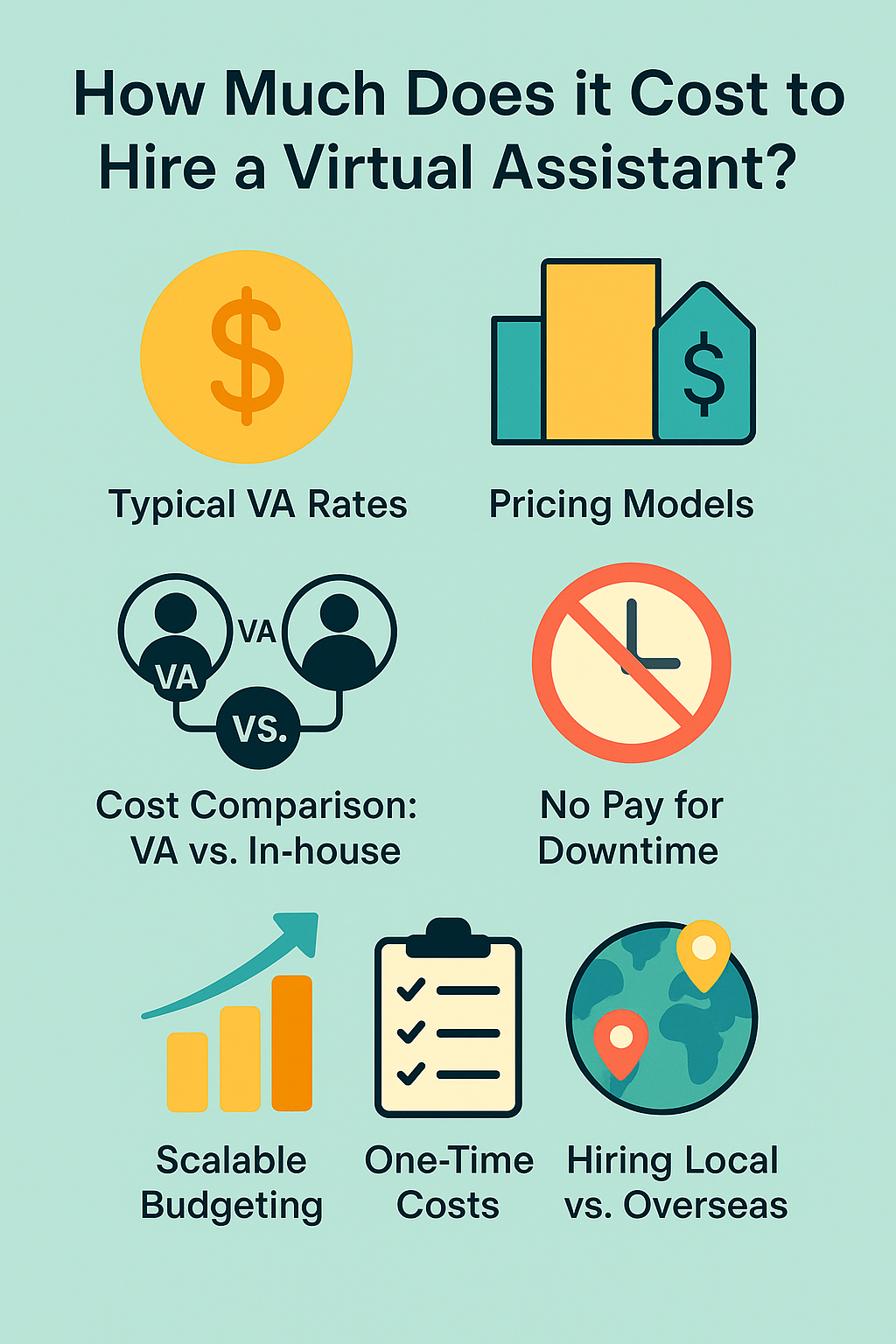
Businesses often turn to remote support to reduce expenses without sacrificing quality. Understanding what you’ll pay for a virtual assistant depends on the professional’s location, skill level, and the nature of the tasks you assign.
The following guide breaks down typical rates, payment options, and cost comparisons so you can confidently plan your budget.
➤ Typical VA Rates (Philippines and India)
Outsourcing hubs such as the Philippines and India offer a wide range of rates that undercut local Australian labour costs. Entry-level assistants handling basic tasks, such as email management or calendar coordination, charge AUD 624 per month. Those with experience in customer service, content writing, or social media management typically command around AUD 2,080 per month.
➤ Pricing Models
Virtual professionals offer flexible billing options that cater to diverse requirements. Monthly billing remains the most common, where you pay only for the actual work logged in for the month. You agree on a total cost in advance. Businesses often begin with an initial month of trial work, and once they are satisfied with the work quality, they transition to a steady workflow.
➤ Cost Comparison: VA vs In-house in Australia
Filling an in-office role has significant overheads beyond salary. For example, a full-time administrative assistant in Sydney might earn around AUD 50,000 annually, with superannuation contributions of 10.5%, paid leave entitlements and workers’ compensation insurance. You’re also responsible for office space, equipment and training. By contrast, remote professionals work from their premises using their tools. You avoid benefit payments, employment taxes and idle downtime costs. Even seasoned VAs with specialised skills remain far more affordable than the total outlay for an equivalent in-house employee.
➤ No Pay for Downtime
One clear financial advantage of a remote assistant is that billing reflects only active work. You’re never charged for breaks or slow periods when you hire virtual assistants. This contrasts with a salaried staff member who receives a fixed wage irrespective of daily output. Many assistants use time-tracking software to log hours, offering full transparency on tasks completed. That arrangement motivates efficiency, encourages completion of work within agreed-upon windows, and ensures every dollar spent produces tangible results.
➤ One-Time Costs
While most expenses are ongoing, there can be upfront investments. Onboarding a new assistant requires your time to explain processes, introduce software and provide training materials. You may need to add them to project-management platforms, subscribe to extra licences for tools like Trello or Slack, or purchase specialised apps for your workflow. If you engage via a freelance marketplace, platform fees may apply. Agencies typically charge a one-off setup fee or slightly mark-up monthly rates to cover candidate vetting and project management. These initial outlays are modest compared with the savings realised over months of efficient support.
➤ Hiring Local vs Overseas
Working in the same time zone and sharing cultural norms can simplify collaboration and communication. Local options offer convenience and ease of management for businesses with flexible budgets. Those operating on tighter margins frequently look offshore for lower rates without compromising capability. Professional assistants from the Philippines or India provide excellent cost-to-skill ratios, making remote engagement a beautiful solution for many Australian enterprises.
Why are the Philippines and India the leading Sources of Remote Support?
Sourcing assistance from overseas has become standard practice for many Australian businesses. These two nations stand out because they deliver expert help at competitive rates while aligning closely with Australian business expectations.
Here are the key reasons why these two nations have emerged as preferred destinations for outsourcing.
➤ Skilled and Cost-Effective Workforce
Both countries boast large pools of university-educated professionals fluent in English and experienced across multiple disciplines. Specialisations include administrative support, customer service, marketing, IT, and finance. Local living costs allow these experts to offer their time at rates that substantially undercut Australian wage levels. The balance of quality and affordability allows organisations to access top talent without inflating overheads.
➤ Cultural Compatibility
Effective collaboration depends on more than technical skills; it requires understanding workplace norms. Australian media and business practices strongly influence the Philippines, so professionals there quickly grasp the tone and expectations common among Australian firms. India’s long history in global outsourcing means many providers are well-versed in international standards, tools and etiquette. Both groups are comfortable adapting communication styles, whether for customer-facing duties or internal coordination, which reduces the need for lengthy explanations and revisions.
➤ Time Zone Alignment and Coverage
Smooth operations often hinge on responsive communication and timely task execution. A two- to three-hour time difference between eastern Australia and the Philippines allows same-day turnarounds and overlapping work hours for real-time check-ins. Perth operates at the same time as Manila, simplifying schedule coordination. India’s four-and-a-half-hour difference still permits afternoon overlap, which is ideal for handing off tasks at day’s end. Many professionals in these regions also offer flexible schedules, extending your operational window beyond typical 9-to-5 hours and enhancing overall efficiency.
➤ Extensive Talent Pools and Support Ecosystems
Dedicated platforms in both nations list thousands of specialists. In the Philippines, online job portals connect employers with remote assistants skilled in administration, graphic design, writing and beyond. India’s established outsourcing sector provides access to various services through agencies and freelance marketplaces. Both countries feature training centres focussed on professional development—courses in business communication, software tools, and accent neutralisation ensure candidates arrive job-ready. This comprehensive infrastructure streamlines recruitment and guarantees a supply of capable applicants prepared for diverse roles.
➤ Familiarity with Australian Business Practices
Many professionals from these regions have direct experience working with Australian clients. They understand local software ecosystems—Xero, MYOB, Trello and Slack are commonly used—and are aware of public holidays, regional time zones and peak trading periods. Agencies geared towards the Australian market often train staff in local etiquette, slang and customer service norms. This head-start reduces onboarding effort, allowing remote assistants to integrate quickly and perform effectively.
➤ Reliability and Commitment
Reputation matters when selecting remote support. Filipino assistants are known for their loyalty, punctuality, and team-oriented attitude. They often take ownership of tasks and communicate proactively to meet deadlines. Indian professionals frequently excel at technical problem-solving and data handling, reflecting the country’s strong STEM focus and outsourcing pedigree. Both groups demonstrate a readiness to address challenges independently and an eagerness to maintain high standards. While individual vetting remains essential, these nations consistently produce candidates who excel as long-term partners.
Best Practices for Hiring and Working with a Virtual Assistant
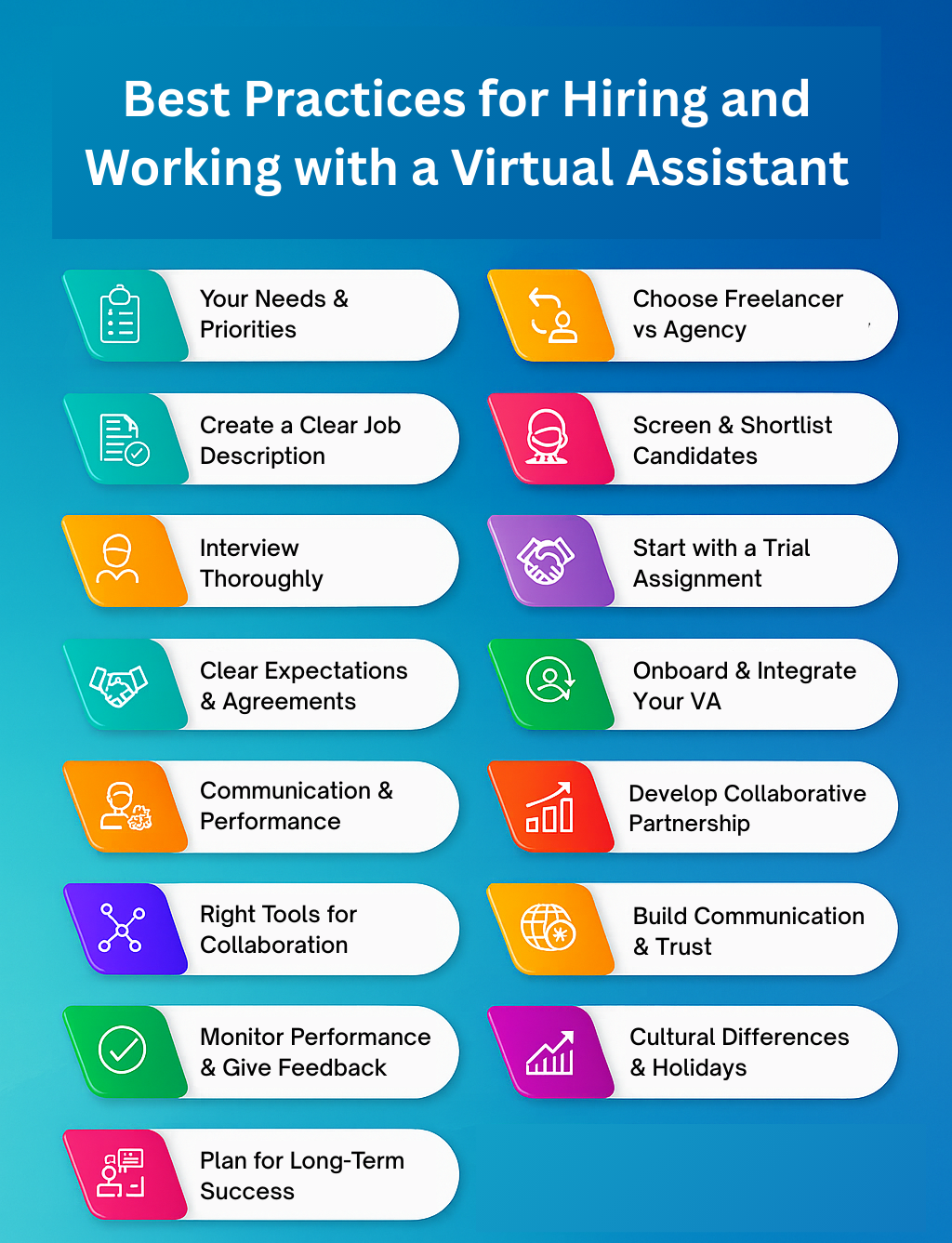
Integrating remote assistance can transform your workflow. To hire virtual assistants and establish a strong collaboration, follow these best practices:
1. Identify Your Needs and Priorities
Before beginning the search, map out your routine responsibilities and strategic projects. Keep a simple log over one or two weeks, noting how much time each task occupies and its impact on your objectives. This process helps distinguish high-value work, like client meetings and product development, from repetitive chores that can be delegated. Focus on tasks that:
- Audit Your Activities: Record daily duties and the time spent on each using a spreadsheet or time-tracking app.
- Group-Related Tasks: Cluster similar duties (for example, email triage, calendar management, and client follow-ups) to streamline handover.
- Estimate Time and Budget: Decide how many hours per month you can allocate to remote support and set a realistic budget.
- Define Clear Outcomes: Specify what success looks like for each task (for instance, an empty inbox by day’s end or social posts scheduled a week ahead)
A thorough needs assessment ensures you brief candidates accurately.
2. Choose the Right Hiring Model (Freelancer vs Agency)
You can engage an independent professional or partner with an agency. Direct freelancers offer flexibility in rate negotiation and closer control over selection. Platforms such as Upwork or specialised virtual assistant sites allow you to review portfolios and client ratings and negotiate terms directly.
On the other hand, an agency handles candidate vetting, contracts, timesheets and even performance management. While agency fees may be higher, they often guarantee a replacement if the match is not ideal. Your choice should reflect how much time you can invest in recruitment and whether you prefer a hands-on approach or a managed service.
3. Create a Clear Job Description
A precise brief attracts candidates who fit your needs from the outset. Include:
- Role Summary: One or two sentences outlining the position’s purpose.
- Key Responsibilities: List tasks with estimated hours, such as 15 hours per week for inbox management and appointment scheduling.
- Required Experience & Skills: Proficiencies in technical areas, such as Xero bookkeeping or WordPress publishing, and soft skills, including excellent written English, are required.
- Availability and Time Zone: Specify overlap requirements, such as “at least two hours of overlap with AEST for daily check-ins.”
- Tools and Systems: Name platforms you use (Slack, Asana, Shopify, etc.).
- Application Instructions: Request work samples or a brief proposal outlining their approach to a representative task.
This detail helps filter out unsuitable applicants and speeds up the screening process.
4. Screen and Shortlist Candidates
Once applications arrive, follow a structured review:
- Review Proposals: Match skills and experience to your priorities, and note clarity of response.
- Check Portfolios and References: Ask for examples of similar work and seek brief feedback from past clients.
- Assess Communication: Evaluate responsiveness and attention to detail through a short scenario or written exercise.
- Identify Red Flags: Beware applicants who miss key instructions or respond with generic replies.
Shortlist three to five individuals who meet your criteria for interviews or trial tasks.
5. Interview Thoroughly (and Look for Communication Skills)
A brief video or voice call of 15–30 minutes helps confirm fit:
- Technical Experience: Ask, “Which calendar-management tools have you used, and how did you structure scheduling for multiple executives?”
- Availability and Workload: Clarify, “Can you commit to regular hours and maintain at least two hours of overlap with AEST?”
- Communication Preferences: Explore, “Do you prefer Slack, email or another platform for day-to-day updates?”
- Scenario Questions: Pose, “How would you handle a client email that requires urgent escalation?”
- Work Environment: Confirm they have a reliable internet connection and a dedicated workspace.
Assess not only content but also clarity, professionalism and eagerness to contribute.
6. Start with a Trial Assignment
A paid trial reveals how they perform under real conditions:
- Choose a Representative Task: Select work you assign regularly, such as drafting social media captions or managing a day’s inbox.
- Provide Detailed Instructions: Share templates, access credentials and examples of expected format or tone.
- Set Clear Deliverables: Define output (for instance, “Prepare five social posts scheduled in Buffer by the end of the trial”).
- Allocate Limited Hours: Fund a two- to three-hour trial to measure efficiency and quality of work.
- Offer Prompt Feedback: Discuss strengths and areas for improvement immediately after completion.
This exercise clarifies reliability, attention to detail and ability to follow directions.
7. Set Clear Expectations and Agreements
Formalise the working arrangement in writing:
- Duties and Deliverables: Outline daily, weekly and monthly tasks.
- Working Hours and Availability: Specify core overlap times and response expectations.
- Communication Methods and Check-Ins: Agree on update frequency (daily email summary or weekly video call).
- Feedback Process: Establish how revisions will be handled and questions answered.
- Payment Terms: Clarify monthly fixed rate, billing cycle and payment platform (i.e. PayPal, Wise or escrow).
- Confidentiality: Include an NDA if they handle sensitive data.
A written agreement prevents misunderstandings and promotes accountability.
8. Onboard and Integrate Your VA
Effective induction accelerates productivity:
- Access and Tools Setup: Create company email; grant access to project boards, shared drives and communication channels.
- Team Introductions: Schedule a welcome call with key staff to explain workflows and reporting lines.
- Standard Operating Procedures (SOPs): Provide written guides, checklists and templates for recurring tasks.
- Training Sessions: Offer screen-share walkthroughs of specialised software or internal systems.
- Business Context: Share your mission, customer profiles and brand guidelines to inform decision-making.
- Early Feedback: Hold a review after the first week to refine processes and address questions.
A comprehensive onboarding process encourages independence and a sense of belonging.
9. Maintain Ongoing Communication and Performance Reviews
Regular check-ins reinforce alignment and continuous improvement:
- Weekly or Biweekly Meetings: Discuss completed work, upcoming priorities and any obstacles.
- Monthly Performance Reviews: Evaluate against agreed KPIs, identify training needs and adjust workload as necessary.
- Continuous Improvement: Invite suggestions for process enhancements or tool optimisation.
Use shared dashboards or spreadsheets to track progress transparently and keep both parties accountable.
10. Develop a Collaborative Partnership
Cultivate loyalty and motivation by involving your VA in broader initiatives:
- Invite Participation in Planning: Include them in project-planning sessions or brainstorming calls.
- Celebrate Milestones: Acknowledge successful project completions or consistent performance.
- Offer Growth Opportunities: Provide chances to learn new tools or take on fresh responsibilities.
A supportive environment encourages a long-term partnership that adapts to evolving business needs.
11. Use the Right Tools for Collaboration
Efficient cooperation with remote team members relies on choosing and implementing suitable platforms. When hiring a virtual assistant, investing time in selecting tools that support clear communication, task tracking and secure data sharing creates a foundation for a productive partnership, regardless of geographic separation.
Here are some practical tools to consider:
Establishing a coherent digital workspace means identifying systems that cover every aspect of your collaboration, from planning to execution and reporting. Each tool category plays a distinct role in streamlining workflows, preserving transparency and preventing misunderstandings.
Project Management
Tools like Trello, Asana, or Monday.com are perfect for assigning tasks, setting deadlines, and tracking progress. You can create a visual task list that’s easy to follow, and your VA will always know what’s next in the queue. It’s a simple way to stay organised and avoid things slipping through the cracks.
Communication
While email is fine for formal updates, apps like Slack or Microsoft Teams are great for quick chats or daily check-ins. For real conversations, schedule short catch-up calls using Zoom or Google Meet — even a 15-minute weekly meeting can go a long way. In the first week or two, you may want to check in daily to help get things started.
File Sharing
Use cloud storage platforms like Google Drive, Dropbox, or OneDrive to share documents, reports, templates, and resources. Your VA will always have access to the latest versions, and you can both make updates in real-time without the need for email back-and-forth.
Time Tracking (if needed)
If you’re paying by the hour and want some oversight, consider tools like Toggl Track for a simple, honour-based approach. If you’re using a platform like Upwork, it comes with built-in tracking and screenshot tools. It’s okay to start with more monitoring at the beginning and ease off as trust builds.
Password Management
To securely share access to your online accounts, use a password manager like LastPass or 1Password. These tools enable you to share logins without revealing the actual password, and you can revoke access at any time if the contract ends or roles change.
By setting up these systems early on, you create a virtual workflow that runs smoothly. It prevents confusion, lost tasks, or “I didn’t see that” moments — and makes remote collaboration just as effective as working side by side.
12. Establish Communication and Build Trust
Transparent and regular dialogue forms the backbone of any remote collaboration. Since you and your assistant will not share a physical workspace, you must intentionally create opportunities for connection, clarity and mutual accountability. Begin by agreeing on a routine for progress updates that suits your workflow. A concise end-of-day email summarising completed tasks, outstanding items and any questions keep you in the loop without requiring constant check-ins. Meanwhile, a brief weekly review conducted via video call can cover broader objectives, shifting priorities and performance impressions. This rhythm of communication saves you from chasing status reports and gives your assistant the confidence to operate with autonomy.
Your responsiveness during the early stages signals that questions will be answered swiftly and instructions refined as needed. If a task is returned with outcomes that differ from your expectations, address discrepancies immediately with constructive feedback. Focus on specifying the adjustments required rather than dwelling on mistakes so your assistant can fine-tune their approach and meet your standards. That feedback loop is crucial for building trust, as professionals appreciate knowing precisely how to improve their work and feel recognised for effort when corrections are delivered respectfully.
Cultural sensitivity is vital in remote partnerships, especially when your assistant comes from a background where direct disagreement can be uncomfortable. Encourage open dialogue by emphasising that seeking clarification, voicing concerns, or proposing alternative solutions is acceptable. Creating a psychologically safe environment diminishes the risk of tasks proceeding under false assumptions and fosters genuine collaboration. As your assistant gains’ familiarity with your preferences and style, grant them progressively greater responsibility and refrain from micromanagement. Focusing on outcomes rather than every individual step demonstrates confidence in their capabilities and further cements a relationship built on respect.
Over time, consistent dialogue and positive reinforcement reinforce a shared sense of purpose. Your assistant will come to understand not only what you need but also why those tasks matter. This deeper comprehension fuels proactive problem solving, with your assistant anticipating requirements and contributing suggestions rather than waiting for detailed instructions. Such trust and teamwork unlock the full potential of remote work, delivering efficiency gains that mirror the benefits of an onsite team member.
13. Monitor Performance and Give Feedback
Maintaining strong standards of quality and reliability depends on defining clear performance criteria and reviewing them regularly. Agree on a limited set of practical measures to track progress: turnaround time for customer replies, error rate in document formatting or the volume of tasks completed within the agreed timeline. Simple metrics such as daily email resolution or weekly scheduling milestones provide tangible targets without overwhelming your assistant with excessive data monitoring. When you understand how you will assess performance, each party can focus on meeting those ideals rather than guessing what success looks like.
Schedule a formal performance discussion after the first month of collaboration to reflect on achievements, challenges and any necessary process refinements. Use specific examples from recent work to highlight strengths and pinpoint areas for development. Offering praise for well-executed tasks fosters motivation and reinforces the behaviours you value. If errors emerge, present them neutrally and propose practical steps for improvement. Encourage your assistant to self-evaluate, noting aspects they found straightforward and areas where they would welcome training or resource updates. This two-way feedback cultivates a sense of joint ownership over outcomes and fosters continuous growth.
Between formal reviews, maintain an open channel for real-time feedback. When you notice a minor issue, such as an overlooked detail or a minor miscommunication, address it promptly through the agreed communication medium. Tackling matters as they arise prevents small inefficiencies from accumulating into larger concerns, signalling that you remain engaged in the partnership. Over time, as your assistant consistently meets or exceeds expectations, you can reduce the frequency of formal check-ins and trust them to deliver autonomously, freeing you to concentrate on strategic priorities.
A sustained focus on performance and feedback ensures that your remote collaboration remains dynamic and aligned with evolving objectives. As your assistant becomes more familiar with your business rhythms, adapt performance standards to reflect higher levels of responsibility. This progression validates their professional growth and maintains high morale, solidifying a relationship that scales with your ambitions.
14. Respect Cultural Differences and Holidays
Working across borders introduces cultural richness but necessitates awareness of varying customs, communication styles and public holiday calendars. Appreciating your assistant’s background signals respect and builds rapport, paving the way for smoother collaboration. Take the initiative to learn about significant observances in their country. For example, your assistant in the Philippines may honour Holy Week with several days off, while a team member in India might celebrate Diwali or Holi. Recognising these events and planning around them prevents surprise absences and demonstrates that you value their traditions as much as your own.
Discuss leave policies openly from the beginning, clarifying how you will handle national and regional holidays in your business calendar. This conversation allows you to anticipate coverage gaps and adjust deadlines or resource allocations in good time. Beyond official holidays, simple acts of acknowledgement can have a powerful effect. Sending a festive greeting or wishing them well for a major festival shows genuine care and nurtures deeper bonds.
Language preferences and communication nuances also warrant sensitivity. In some cultures, polite forms of address convey respect, while others may favour a more informal style. Invite your assistant to share their preferences for greeting styles or meeting etiquette. Simple gestures such as wishing them a good morning or asking after their family create a sense of belonging and encourage loyalty. When your assistant feels understood and respected, they are more likely to invest discretionary effort in anticipating needs and enhancing your business outcomes.
Ultimately, an active stance on cultural respect enriches the working environment, elevates mutual trust and transforms a transactional arrangement into a collaborative partnership. Acknowledging differences with warmth rather than avoidance lays the foundation for enduring professional relationships.
15. Plan for Long-Term Success (or Transition)
As your remote assistant settles into their role and establishes a track record of reliable support, expanding their responsibilities and integrating them more fully into your business operations becomes possible. Share evolving goals and project roadmaps so they understand where their contributions fit in the broader picture. Invite them to create process documentation for recurring tasks, compiling step-by-step guides that serve as training resources for future hires and as a reference for maintaining consistency. Empowering them to map out workflows reinforces their expertise and streamlines future recruitment by providing a ready-made operation manual.
When growth demands a more hands-on deck, consider enlisting your assistant to help onboard new team members. Their insights into daily processes and organisational culture make them ideal mentors for fresh recruits. As they guide newcomers through established procedures, your assistant consolidates their role as a senior collaborator and strengthens their connection to your business’s success.
There may be times when the partnership needs to be concluded, whether due to shifting priorities, budget adjustments, or a mismatch in working styles. Endings handled with clarity and respect foster goodwill and open the door to future collaboration. Provide honest feedback on what worked well and what you could improve that honours your contributions. Offer an appropriate notice period and ensure smooth handover of documents, logins and process guides. This thoughtful closure ensures continuity for your operations and safeguards the professional reputation of both parties.
Planning for the long term or transition means treating your remote assistant not as a temporary resource but as a potential pillar of your extended team. Whether they remain in a support role for years or move on after a few months, a deliberate approach to growth, documentation, and respectful disengagement amplifies the value derived from remote collaboration.
Wrapping Up
- A productive remote partnership requires a purposeful setup, consistent communication, and genuine respect.
- Selecting the best tools for collaboration and establishing transparent routines builds a sturdy framework on which to rely.
- Regular performance monitoring and reciprocal feedback guide improvements, while cultural awareness and sensitivity strengthen trust. Charting a path for growth or a graceful exit keeps all stakeholders aligned and ensures that your business and your assistant benefit from the arrangement.
With these principles in place, you can harness the advantages of remote support to streamline operations, nurture innovation and maintain the agility needed to thrive in a competitive landscape.
 Webential