
Table of Contents
- The Evolution of Virtual Assistant Services
- How AI Tools Enhance Virtual Assistant Efficiency
- Spotlight: Copilot and ChatGPT
- AI Integration Across Applications
- Skill Specialisation: The Future of Hiring Offshore Virtual Assistance
- The Benefits of Hiring Offshore Virtual Assistants with AI Proficiency
- Conclusion
In recent years, artificial intelligence (AI) has redefined productivity across industries, and nowhere is this transformation more visible than in the world of virtual assistant services. The growing adoption of AI-powered tools has enabled virtual personal assistants to work smarter, faster, and more accurately than ever before.
From scheduling meetings and managing emails to generating reports and conducting research, today’s virtual assistants rely on AI technologies like Microsoft Copilot and ChatGPT to deliver exceptional efficiency and precision. For businesses that hire offshore virtual assistants, this combination of human skill and machine intelligence offers an unparalleled advantage: cost-effective, high-quality support that scales effortlessly.
The Evolution of Virtual Assistant Services
Traditional virtual assistant services focused mainly on administrative support — tasks such as calendar management, travel arrangements, or data entry. But the landscape has evolved dramatically.
Modern virtual assistants are no longer limited to routine clerical work. Many now possess specialised skills in areas such as content writing, digital marketing, customer support, bookkeeping, and project coordination. And with AI-driven tools at their disposal, they can handle more complex, value-driven tasks with greater autonomy.
The integration of AI means that a virtual assistant can now:
- Analyse large datasets faster.
- Automate repetitive workflows.
- Draft professional documents or correspondence.
- Conduct market research with accuracy.
- Provide real-time updates and insights to clients.
This synergy between human expertise and artificial intelligence has transformed how organisations approach productivity and delegation.
How AI Tools Enhance Virtual Assistant Efficiency
The efficiency gains of AI come from automation, language understanding, and decision-making capabilities. Let’s look at how these elements combine to support virtual assistants.
1. Automation of Repetitive Tasks
AI tools can handle repetitive, rule-based processes that once consumed hours of manual effort. For instance:
- Email management: AI-powered filters and summarizers automatically categorise and prioritise messages.
- Scheduling: Virtual assistants can rely on AI calendars that auto-suggest meeting times based on preferences and availability.
- Data entry: Optical Character Recognition (OCR) and automation scripts capture and organise data accurately in seconds.
This automation frees up time for virtual assistants to focus on higher-level activities such as strategy, analysis, and creative problem-solving.
2. Enhanced Communication and Language Capabilities
With tools like ChatGPT, virtual assistants can craft clear, professional communication across languages and contexts. Whether it’s writing reports, drafting emails, or creating website content, ChatGPT’s natural language generation capabilities make it easier for VAs to produce high-quality output quickly.
A virtual personal assistant can use ChatGPT to:
- Draft client proposals and presentations.
- Respond to customer inquiries with an accurate, empathetic tone.
- Generate outlines for blogs, newsletters, or marketing materials.
This allows businesses to maintain consistent communication standards without overburdening human resources.
3. Data Analysis and Decision Support
AI doesn’t just automate; it empowers better decisions. Tools like Copilot, which integrates directly into Microsoft 365 applications (Excel, Word, Outlook, and Teams), provide virtual assistants with real-time insights.
For example:
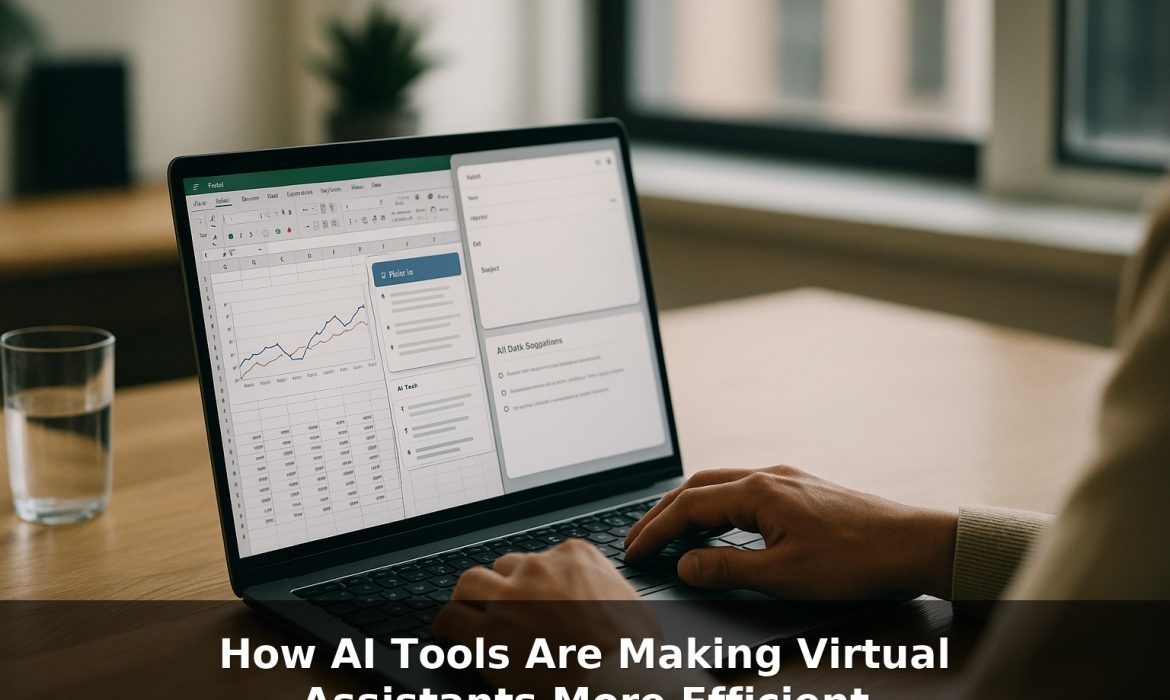
- In Excel, Copilot can summarise trends, generate pivot tables, or analyse budgets without requiring advanced formulas.
- In Word, it can draft documents based on context or instructions.
- In Outlook, it can summarise lengthy email threads and suggest responses.
These features drastically improve the productivity of virtual assistants handling finance reports, project documentation, or executive communications.
Spotlight: Copilot and ChatGPT
Microsoft Copilot
Copilot stands out because of its deep integration within the Microsoft ecosystem. For virtual assistants who already rely on tools like Word, Excel, and Teams, Copilot functions as an intelligent collaborator.
It enables them to:
- Generate summaries of documents and meetings automatically.
- Suggest improvements to writing or presentations.
- Create project plans or timelines in seconds.
- Transform raw data into visual charts and insights.
A virtual assistant using Copilot can complete what once took hours in a fraction of the time, with fewer errors and better results.
ChatGPT
ChatGPT, developed by OpenAI, is another indispensable AI companion for virtual assistants. Its ability to understand natural language and generate contextually accurate responses makes it perfect for communication-heavy roles.
Whether drafting blog posts, editing reports, conducting research, or brainstorming marketing ideas, ChatGPT can assist with almost any language-based task.
Moreover, ChatGPT-powered integrations are now common in productivity tools, CRMs, and project management software. That means a virtual assistant service can easily incorporate ChatGPT into daily workflows, from customer support chatbots to report automation, without disrupting existing systems.
AI Integration Across Applications
It’s not just standalone AI tools that matter; many modern apps now come with built-in AI features that virtual assistants can leverage.
At Kredence Global, we make sure that the VA you are looking for has enough skills to handle major AI tools and work with them to deliver faster and with more accuracy.
For example:
- Notion AI helps organise project notes, summarise meeting minutes, and generate content ideas.
- Grammarly AI enhances communication accuracy.
- Canva AI assists with design generation and visual branding.
- Zapier with AI automates multi-step workflows between platforms like Slack, Google Sheets, and Trello.
When businesses hire offshore virtual assistants, they can ensure that their assistants are proficient in these AI-enhanced platforms, giving them the power to deliver output faster and with better consistency.
Skill Specialisation: The Future of Hiring Offshore Virtual Assistance
As AI tools become more powerful, the role of virtual assistants is shifting toward specialisation. Businesses are no longer just looking for general administrative support; they’re seeking VAs with specific skills who know how to harness AI tools effectively.
For example:
- A content marketing VA trained in ChatGPT can produce SEO-friendly blogs, social media posts, and email campaigns.
- A data analysis VA skilled with Copilot and Excel can provide insights that support decision-making.
- A customer support VA can manage AI chatbots and escalate complex cases efficiently.
By ensuring virtual assistants are trained in these technologies, organisations maximise the benefits of both human and artificial intelligence.
The Benefits of Hiring Offshore Virtual Assistants with AI Proficiency
For companies aiming to scale while maintaining operational efficiency, hiring offshore virtual assistants who are skilled in AI tools is a smart strategy. The benefits include:
- Cost savings: Hiring offshore VAs typically costs less than in-house staff while delivering comparable (or better) output.
- 24/7 availability: Offshore teams often operate across time zones, ensuring round-the-clock support.
- AI-enabled productivity: Trained VAs can use tools like Copilot, ChatGPT, and AI-enhanced apps to handle multiple functions efficiently.
- Scalability: Businesses can easily expand or reduce support levels as needs change.
When coupled with AI capabilities, offshore virtual assistants become an extension of your core team, providing intelligent, flexible, and consistent support.
Conclusion
The fusion of AI technology with human expertise is reshaping the virtual assistant industry. Tools like Copilot and ChatGPT exemplify how automation and intelligence can empower virtual assistants to perform at higher levels of accuracy and creativity.
Whether managing operations, creating content, or supporting executives, AI tools help virtual assistants become true productivity partners, not just task executors.
For businesses that hire offshore virtual assistants or rely on virtual assistant services, this new wave of AI integration means faster turnaround times, smarter workflows, and more strategic support. As AI continues to evolve, virtual assistants who embrace these tools will remain at the forefront of efficiency, innovation, and value creation.
At Kredence Global, we specialise in providing offshore virtual assistants who are not only highly skilled but also trained in cutting-edge AI tools. We empower your business with intelligent, cost-effective support that drives real results.
Partner with Kredence Global today, and discover the next level of virtual assistance.
 Webential